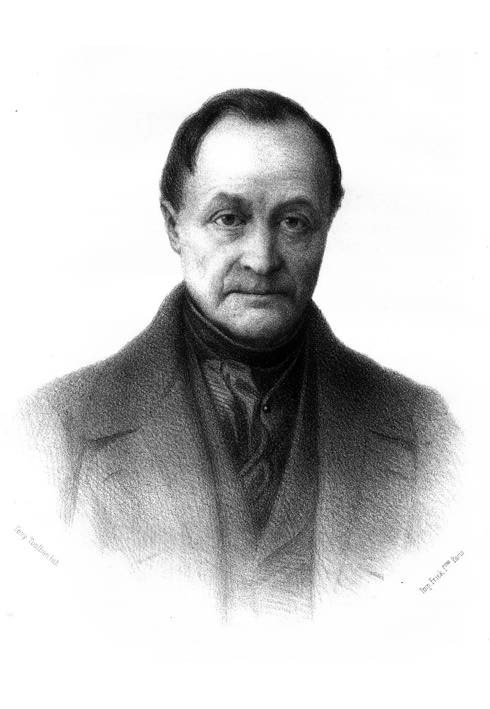
(Condensé de/condensed from Auguste Comte à grands traits/Auguste Comte: A Bird's eye View )
Auguste Comte est surtout connu comme le créateur de la sociologie, dont il a jeté les bases dans ses deux grands traités, le Cours de Philosophie positive (1830-1842) et le Système de Politique positive (1851-1854).
C'est d'ailleurs lui qui a créé le mot sociologie, qui apparaît pour la première fois dans une note de la 47e leçon du Cours.
Mais les contributions d'Auguste Comte à la biologie, plus méconnues, sont loin cependant d'être négligeables. Théoricien de l'importance des milieux et de leur influence sur les êtres vivants, il est un des grands précurseurs de l'écologie scientifique.
Par ailleurs ses prises de position très vives sur des questions comme la médecine et l'école, et ses critiques de la science contemporaine, en font aussi un écologiste "militant" avant la lettre.
En médecine il est un "psychosomaticien" déclaré, et ses attaques contre la psychiatrie "matérialiste" de son temps font aussi de lui un père spirituel de l'antipsychiatrie.
D'une manière générale, son épistémologie, fondée sur la division de la réalité en niveaux de complexité hiérarchisés -- principe de sa classification des sciences -- est étonnamment proche de ce qui est devenu aujourd'hui la théorie générale des systèmes, ou pensée systémique. (Voir aussi sa critique du matérialisme.)
Mais ce sont ses théories sur les fonctions du cerveau qui sont peut-être ses plus étonnantes préfigurations de ce que la science allait mettre des décennies à découvrir. Il a vu en effet la division, actuellement admise, du cerveau en trois systèmes interconnectés :
Il a vu aussi l'existence parallèle d'une pensée verbalisée (localisée aujourd'hui dans l'hémisphère gauche) et d'une intelligence des images (localisée aujourd'hui dans l'hémisphère droit). Il a même prophétisé l'existence d'une intelligence affective (intelligence limbique ?) dont la science n'a pas encore établi l'existence. Mais qui sait ?
Plus important encore, Auguste Comte est l'inventeur du concept (et du mot) d'altruisme. Selon sa théorie, des impulsions bienveillantes, "altruistes", coexistent avec les instincts égoïstes au sein de notre cerveau affectif -- ce qui a été également confirmé par la science moderne. Cette découverte de l'altruisme a fourni à Comte les bases qui lui manquaient pour la construction d'une éthique scientifique qu'il pressentait depuis sa jeunesse, et dont il a fait en 1852 la septième science de sa classification.
En politique, ses exigences très strictes en matière de séparation du spirituel (qui pour lui englobe tout ce qui est du domaine moral, ainsi que la médecine, la science, l'éducation, les arts) et du temporel (c'est-à-dire du pouvoir politique) font de lui le premier théoricien de l'antitotalitarisme (voir aussi Auguste Comte et les Libertés).
Par ailleurs il anticipe très nettement sur ce qui deviendra plus tard l'anticolonialisme (en particulier il est intraitable sur la nécessité pour la France de "rendre l'Algérie aux Arabes") et sur la non-violence d'un Gandhi.
Dans le domaine social, Comte accorde la plus grande importance au problème de "l'incorporation du prolétariat dans la société moderne", un prolétariat qu'il décrit en une phrase restée célèbre comme "seulement campé aux portes de la cité".
De fait beaucoup de ses disciples joueront un rôle de premier plan dans les luttes ouvrières et dans la constitution des mouvements syndicalistes modernes. Sait-on par exemple que c'est sous la présidence d'un positiviste, Edward Spencer Beesly, que fut organisée à Londres en 1863 la première Internationale ?
Quant aux femmes il leur reconnaît dans l'humanité future un rôle de tout premier plan, allant même jusqu'à déclarer que "la révolution féminine doit maintenant compléter la révolution prolétaire".
D'une manière générale, il accorde dans la société un rôle régulateur fondamental à l'opinion publique, dont il établit la théorie.
Dans le domaine religieux, Comte, qui prêche le respect mutuel de toutes les religions, et annonce leur convergence finale en une grande Religion de l'Humanité, est bien entendu l'un des grands précurseurs de l'oecuménisme.
Auguste Comte is mostly known as the creator of the science of sociology, the foundations of which he laid in his two main treatises, the Course in Positive Philosophy (1830-1842) and the System of Positive Policy (1851-1854).
He coined himself the word sociology, which appeared for the first time in a footnote to the 47th lesson of the Course.
But Auguste Comte's contributions to biology, if less known, are far from negligible. Theorician of the importance of milieus and of their influence upon living beings, he is one of the great precursors of scientific ecology.
Incidentally his bold pronouncements on such questions as medicine and schooling, together with his bitter indictment of contemporary science, make him something of an early ecological activist.
In medicine he is an overt psychosomatician, and through his criticism of the "materialistic" psychiatry of his times he may well be considered also a forefather of antipsychiatry.
Broadly speaking, his epistemology, based on the breaking down of reality into hierarchically ordered levels of complexity--the principle of his classification of sciences--is strikingly akin to what has come to be known as general system theory, or systems thinking. (See also his criticism of materialism.)
But it is his theory about the functions of the brain which provides us with the most striking example of his ability to anticipate what science took tens of years to re-discover. He figured out the--today generally accepted--division of the brain into three interconnected systems:
He also figured out the parallel existence of a language-based intelligence (today localized in the left hemisphere) and an image-based intelligence (today localized in the right hemisphere). He even prophesized the existence of an affect-based intelligence (limbic intelligence?) which science hasn't discovered yet. But who knows?
Even more important, Auguste Comte is also the inventor of the concept (and the word) of altruism. According to his theory, innate benevolent, "altruistic", drives co-exist with egoistic instincts within our affective brain--an intuition that has also been confirmed by modern science. This discovery of altruism gave Comte the basis he needed for the construction of the science of ethics he had been anticipating since his youth--a science he made in 1852 the seventh in his classification.
In politics, his strict advocacy of separating the spiritual (which in his views includes whatever belongs to the moral realm, as well as medicine, science, education, the arts) from the temporal (i.e., the political power) makes him the first theorician of antitotalitarianism (see also Auguste Comte and Liberties).
Moreover, he largely anticipates what will later become anticolonialism (in particular he is adamant about the necessity for France to "give Algeria back to Arabs") as well as Gandhian non-violence.
In the social domain, Comte assigns the highest priority to the problem of "incorporating the proletariat into modern society". A proletariat he describes in a famous sentence as "merely encamped outside the city gates".
As a matter of fact a considerable number of his disciples did play a major part in the labour movement and in the constitution of modern trade-unionism. For example, it is seldom noticed that the First International was convened in London en 1863 under the chairmanship of a positivist, Edward Spencer Beesly.
As for women, Comte foresees they'll play in tomorrow's humanity a foremost role. He even goes so far as to declare that "the feminine revolution must now complete the proletarian revolution".
Generally speaking, he assigns in society a fondamental regulatory function to public opinion, of which he establishes the theory.
In the religious domain, Comte, who advocates the mutual respect of all religions, and announces their final convergence into a global Religion of Humanity, is obviously one of the great precursors of oecumenism.